

![[personal profile]](https://www.dreamwidth.org/img/silk/identity/user.png)
Despite slightly more comfortable weather (81°F/51%) I'm not having a very comfortable day. Listless, dizzy, achy -- and though I get hungry, I really don't feel like cooking, or even eating; all I want to do is drink, and I don't reall want to drink water. I'm craving large quantities of OJ or Gatorade, neither of which I really ought to be drinking all that much of, and I'm nearly out of Gatorade anyhow. So I'll try to settle for fizzy water (the flavoured seltzer w/o sweeteners) and see whether I can muster the energy to be productive at some point.
Well, I've been sortakinda productive-ish: I just did part of an experiment I'd been meaning to do. When I play recorder on stage, I usually just have one mic on a boom pointing at the window, but I recall having read that half the sound comes out the foot (in a rather narrow dispersion pattern, IIRC, but I imagine it usually spreads out more after bouncing off the floor), and I think I remember that having two mics on a recorder mattered in the recording studio. Since I've started playing with Audacity on my Debian box, I've been meaning to set up a pair of microphones and take a closer look.
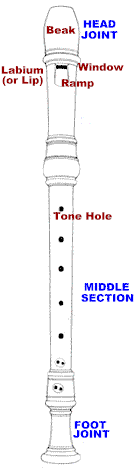
I picked my two mics with sounds most similar to each other, pointed one at the window of my tenor recorder and the other at the foot, panned them hard-left and hard-right respectively, played a few notes, then swapped the mics and recorded a few more notes. I need to play around more with exact placement of each microphone (and a less noisy time of day), but so far the results are: where the mic is placed makes more of a difference than whch mic (of this particular pair) it is; and neither really sounds like a good recording of a recorder until they're mixed together. Though I can hear the difference well enough, I can't make out the differences clearly on the waveform plot, but this isn't a very large monitor ... (I can, however, see a slight phase difference between the two microphones).
[ETA: As noted in a comment to a later entry, listening to this recording (5MB WAV) on a different computer in a quieter neighbourhood, it sounded a bit different than it did at home. See the comment for details.]
Doing this with a pair of identical (and higher-grade) microphones would be good too. I should probably just arrange to take my recorders up to Emory's studio sometime... Or ask him if he's got WAV files from a two-mic recording of a recorder lying around to email me.
A harder question is whether this makes enough of a difference
to care about on stage (it's clearly something to continue to
worry about in a recording studio). Probably not ... though,
having flipped past clip-on saxophone and brass mics in a catalog,
I'd been toying the idea of a clip-on dual-mic recorder rig that
could be moved quickly from one recorder to another. (It would
look cool and sound better, but it's probably not worth the added
complexity, the need for yet another channel, and the risk of
throwing off the balance of the instrument and making it harder
to play, given that most of the time a live PA is not exactly
audiophile hi-fidelity unless you're playing the Meyerhoff or
the Kennedy Center, and the subtlety-of-tone of the recorder
probably gets lost behind the guitar when playing live anyhow.
I could see maybe getting lead recorder ![[livejournal.com profile]](https://www.dreamwidth.org/img/external/lj-userinfo.gif) silmaril a
second channel in the interest of tone if enough people could
hear the difference, but not for my alto/tenor/bass parts.)
Okay, maybe that wasn't such a hard question after all.
silmaril a
second channel in the interest of tone if enough people could
hear the difference, but not for my alto/tenor/bass parts.)
Okay, maybe that wasn't such a hard question after all.
And other than futzing around composing this journal entry, I also goofed off with a quiz-meme and an "analyze data about your blog" toy:
dglenn's LiveJournal popularity rating is 5.15/10.dglenn is more popular than 99.83% of all LiveJournal users.dglenn is more popular than 89.9% of their mutual friends. How popular are you? How popular are you?LJ Popularity created by thehumangame. |
and:

Which Historical Lunatic Are You?
From the fecund loins of Rum and Monkey.
Getting Emporor Norton I for that quiz amuses me a great deal. I've always thought Norton was kinda cool.
(no subject)
(no subject)
(no subject)
Miking recorders
Re: Miking recorders
I haven't gotten this far in my experiments yet, but what I've read suggests that the foot mic really ought to be farther away[**] than is likely to be feasible in a concert setting, so even using two mics per recorder on stage is still probably going to involve compromises.
On stage, especially at a festival where you're at the mercy of somebody else's equipment, you may have to worry about the number of channels and microphones and stands available, as well as the strictly acoustic issues. An attached mic rig, if it doesn't make the instrument unwieldy, removes stands and number-of-mics from the equation (because, presumably, the musician would own the dedicated mics and bring them along), and presents the possibility of pre-mixing the two mics so as to still only use a single channel at the sound board. But both mics will still probably be closer than they should be for optimal tone (though this will improve the feedback situation!).
But for recording, whoa, tone really, really matters. And even if someone can't do it perfectly, there's a lot to be said for Not Doing It Wrong. The difference between a single close-mic and the pair (or a room mic if the room supports it) is a big deal.
[*] There are a bunch of ways to record a guitar. For the second (http://cdbaby.com/cd/homespunceilidh2) Homespun Ceilidh Band (http://www.homespunceilidh.com) album, my guitar was recorded with, I think, four or five mics at once (off the top of my head I recall: a large-diaphragm room mic several feet away, and neck and body close mics, with a stereo pair being involved somewhere (body?), and a fuzzy recollection of a fifth mic somewhere). But using just two close mics is pretty common for guitar (and on stage (at least) you can get away with a single mic positioned just right). On stage, I use a coil pickup in the 6-string and a clip-on condenser mic on the 12-string. If I were doing "sit on a stool and play impressively delicate stuff", I'd want two guitar mics on booms; but when I play guitar on stage I'm mostly doing the "jump around and make a whole lot of crunchy chords playing high-energy music with eight other people" thing, so attached pickups that get the basic tone[***] are an appropriate solution until I get into the studio. I see a similar set of choices WRT recorders on stage: the ideal audiophile solution might not fit the compromises of live sound in a festival setting.
[**] Similarly, a violin really sounds best at a distance farther than you want to put a mic in any situation where feedback or background noise (including bleed from other instruments) are issues.
[***] I'm still picky enough that not just any transducers will do.
Re: Miking recorders
For something like a recorder, I would be thinking in terms of a small mic stand on the floor with a cardioid pattern mic pointing upward. Then I would probably use a small boom to place another cardioid mic near the recorder's window. If you move around a lot, jumping, etc. not swaying in a chair, then you are almost required to look at that mics attached to the instrument's body.
The mics don't have to identical, remember that you are picking up two different types of sound. Also, the slight phase differences that you saw are important. When I mic hand drums (congas, whatever...) I have been known to hang a condenser pointing down at the drum heads and place something like an SM57 under & pointing up. That way, I get the hand slaps, and the first sound from the heads, and the very slightly out of phase beefier sound from the drum body.
Something that you might think about for your gear for PA use & recording is to get a small 4 to 8 channel "sub-mixer" and put together a small mic snake with your mics, etc. That way, you can quickly mute & unmute various instruments, and feed one consistent signal to the house mixer (something sound guys like :) ).
Janice
Re: Miking recorders
I want identical mics specifically for the purpose of comparing the two sounds in tests like this. I agree that they don't have to be (and possibly shouldn't be) identical in actual use as opposed to "the lab". Though if I were to try to build a dual-attached-mic rig, I'd probably wind up using identical or nearly identical mics anyhow: tiny cardioid condensers -- lavalier or mini-gooseneck style -- for weight reasons.
The info about how you mic your drum (and why) is a great example here. Thanks!
I was thinking about just a two-channel, belt-mounted mixer for attached recorder mics, though if that winds up being expensive or needs to be custom-built, then yah, it'd be easier to build a custom two-channel snake to a small stage mixer. (Hmm. Just how bad an idea would it be to convert the mic signals to unbalanced so they can share a single standard XLR cable for the short distance from the instrument to the stage submixer?)
But I've definitely thought about submixers before, either a drum mixer ifwhen I ever need to mic my drum kit, or just a "tie up fewer channels at the console with all the instruments I use" mixer.
Re: Miking recorders