

![[personal profile]](https://www.dreamwidth.org/img/silk/identity/user.png) eftychia at 01:38am on 2010-11-06
eftychia at 01:38am on 2010-11-06I don't understand batteries (well, cells) as well as I thought I did.
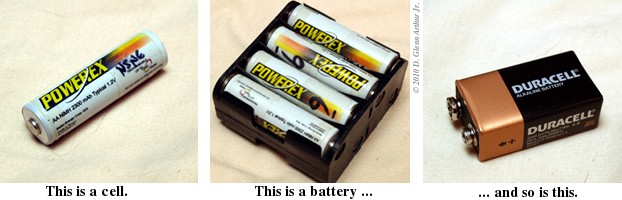
That is, I may (!) understand carbon-zinc, alkaline, and lead-acid as well as I thought I did (or I may merely have not yet been smacked in the face with the bits I've got wrong), and I may even understand nickle-cadmium cells, but it has been made clear to me that I don't understand nickle metal hydride cells.
(if you came directly here and want to skip past the paragraphs that would've been hidden by <lj-cut>, here's a skip-ahead link.)
From what I understand of primary cells, they start out at some voltage slightly higher than their nominal voltage, and as they get used up, the voltage gradually drops. When the actual voltage gets too low for the device the cell is in, usually at some voltage well below the cell's nominal voltage, the battery is considered 'dead' and discarded. Pretty simple. A voltmeter tells me clearly and simply whether the battery still has 'juice' in it.
Apart from the business of constantly getting recharged if it's in a car or occasionally getting recharged if it's on a boat or in a tent, a lead-acid battery appears to work similarly. We just recharge them when they go flat, instead of throwing 'em away. The failure modes I've seen are (a) one or more cells refusing to 'take' a charge, and (b) one or more cells failing to hold a charge. These are easy to check with a voltmeter: if, after what should've been enough time on the charger, the voltage is too low, the battery isn't charging. If the (nominally 12 V) battery reads 14 V when I go to bed and 11 V when I wake up, it's not retaining its charge. If neither of those problems shows up on the voltmeter, I can expect the battery to do everything I normally count on that sort of battery to do.
I was aware that at least one kind of secondary cell (lithium ion?) goes bad over time whether it's used or not, and other types go bad after enough hundreds of charging cycles, but I figured the failure mode for a NiMH cell would be much like that for lead-acid: it would either not charge, or not stay charged, and my trusty voltmeter would help me tell what was going on. But apparently things aren't quite that simple...
Here's where I get confused. I've got a lot of AA NiMH cells (nominally 1.2 V; fully charged, somewhere between 1.38 V and 1.43 V) that I mostly use in my digital camera and my flash strobes. I've got a dumb charger that appears to work on an internal timer, and a smarter charger that has some way to detect when each cell is charged and shut off each slot when the cell in that slot is done. The fancy charger also tells me when it thinks a cell has gone bad -- the charging indicator flashes to tell me that cell ain't playing nice. And a few sets of cells no longer play nice in that charger.
Here's the thing: if I put those cells in the dumb charger, they come out charged to around 1.4 V each, and hold that charge about as long as (inexpensive) brand new NiMH cells do. But when I put them in my camera, the camera's battery indicator either reads only half-charged (for one set) or says they're completely dead (the other sets). When I take them out of the camera and check them with the voltmeter again, they still say ~1.4 V. I dug up a AA-powered flashlight in which to try a couple of ones my camera says are completely dead, and the flashlight looks nice and bright. (I haven't done a prolonged test to see how long they last, yet.) The camera and the smart charger agree that they're bad, but they've failed in a way that I'm not familiar with. (Of course, I was bitten by this when I was shooting the house my brother was selling, and thought I was prepared because I had brought three spare sets ... only to find out that none of the rechargeable batteries I had brought actually worked, despite having been freshly charged. Fortunately I was able to finish up that day on a set of alkalines that I'd planned to use in a flash.)
I'm assuming that these cells have reached the end of their useful life (at least as far as photography is concerned) and cannot be redeemed, so I'm not asking for suggestions on how to restore them (though gosh, if it turns out there is a way, great). But it really bothers me that I don't understand what is going on here, and that the only way I currently have of testing 'em is to see whether the smart charger complains (which it doesn't always do!).
It also bothers me that I no longer have enough rechargeables to get me through a whole Pennsic, but that situation is manageable as long as I have access to power I can plug the chargers into every so often, and don't shoot enough to burn through too many of my still-useful sets in one day.
I'm guessing, with my admittedly naive understanding of electronics ("a little knowledge is ..."), that it has something to do with performance under load versus performance unloaded, and that if I stick the right resistor in the right place I might see some difference between the still-okay cells and the pining-for-the-fjords cells on the voltmeter. Is that a useful guess?
And as long as I'm asking questions about such things, why do so few manufacturers put the amp-hour ratings on the cells or on the packaging so I can compare products between or within brands? And what brands/models do folks like for both capacity and low self-discharge rates? I got some used Powerex 2300 mAh cells with my camera, and they were great until half of them went bad (the rest are still okay but don't seem to last as long on a charge as they used to) -- but I've never seen those in stores (I can find them online). Is that a brand I should stick with?
(no subject)
(no subject)
The whole thing burns me up. AAs are supposed to output 1.5V, not 1.2 that lots of rechargeables 'cheat' to, even if a lot of devices will work with slightly low voltages and manufacturers can get away with it. I've run into the problem you had and basically had to give up on rechargeables for that camera; effective battery life was ridiculous because it'd refuse to run the batteries down at all.
As for why your NiMH are behaving weirder than the others, well...their discharge voltage under larger load (1.2V) is much lower than their voltage under small loads (the 1.4 or so that you saw). If you had a way to measure their output while they were powering that flashlight, you might be able to read the 1.2, but your voltmeter is (purposely) not putting a large load on them. Your camera does, and I'm guessing that's why it falls over. On repeated charging, the effect is pronounced, I assume for the same reason batteries die after a number of duty cycles...the charging doesn't really fully discharge and you end up with bands of charge/discharge in the batteries.
...And according to wikipedia, charging NiMH batteries is a black art and not even the manufacturers can agree on what method to use. You'd think this would be easy to determine experimentally.
Finally, it might be that your camera is trying to protect the batteries. If one of the batteries is weaker than its mates, it will discharge first and get driven in reverse by the others, which can damage it. The camera might be trying to guess this is occurring and refuse to draw power. I guess this is why there are always warnings about not mixing batteries of different types, charge levels, and ages.