

![[personal profile]](https://www.dreamwidth.org/img/silk/identity/user.png) eftychia at 09:28am on 2011-02-26
eftychia at 09:28am on 2011-02-26So I've got this keyboard that I have a problem with. And I mean that literally, though, uh, I guess I mean that as an example of synecdoche as well, since the keyboard in question is in fact part of a synthesizer. And I think I know, at basic level, the solution to my problem ... but I'm having trouble getting to the spots I need to reach to solve the problem, and I'm hoping that my friends can help. The problem, and my attempts to understand/fix it so far, go like this:
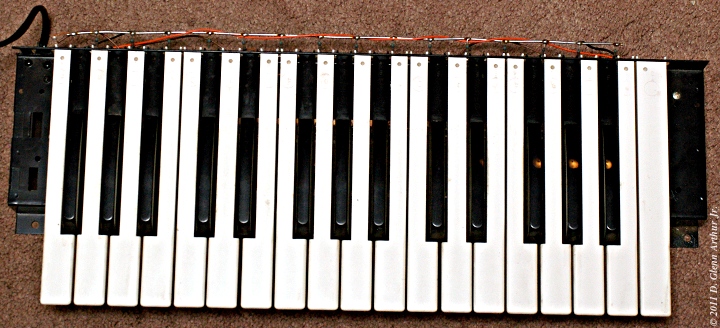
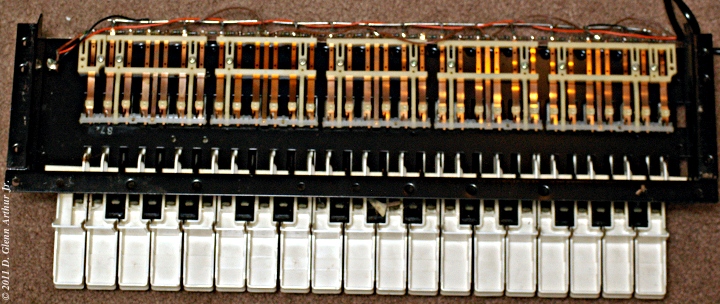
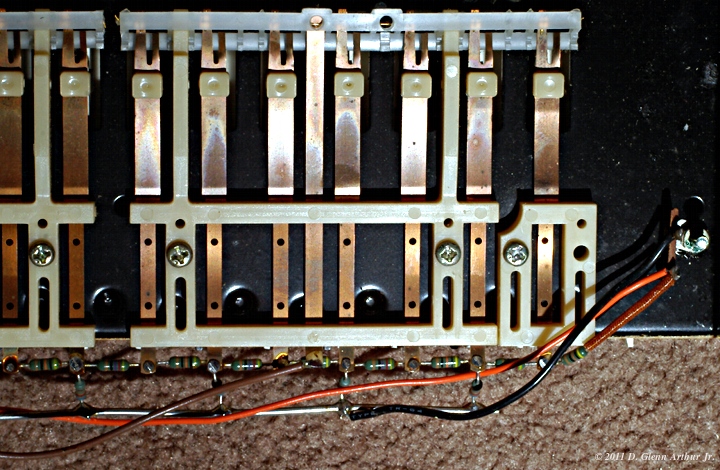
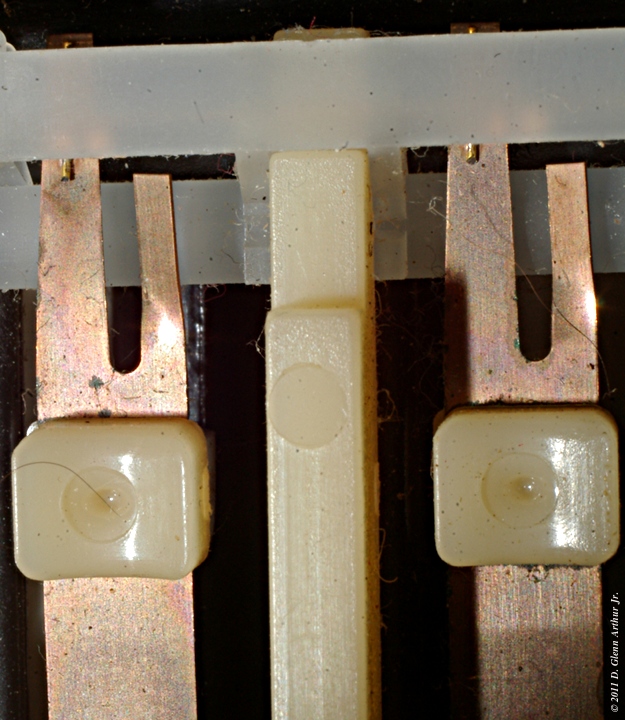
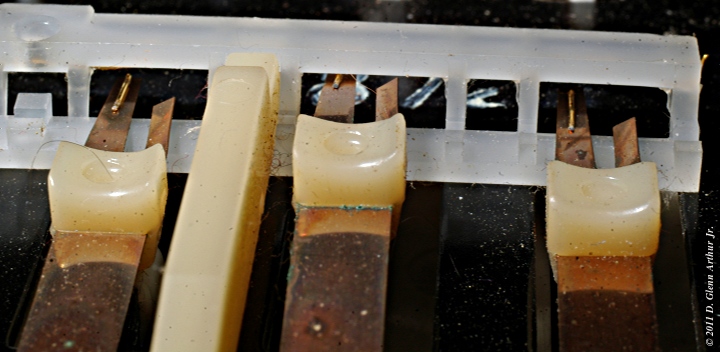
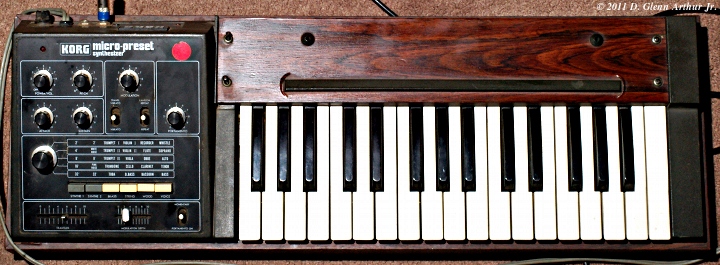
I've got this old, monophonic, analog synthesizer that I've owned since 1980 or 1981, which I'd like to be able to play (or at least play with) again, but for the past, uh, [handwave] fifteen years [-ish] I haven't been able to play it in tune. Pressing the keys produces inconsistent pitches, often a bit of a warble, and despite the synthesizer having been designed to have neither velocity sensitivity nor aftertouch, wiggling your finger on a key usually produces more shifts in pitch. The design of the keyboard appears to be pretty simple (straightforward for a monophonic synth, as I understand it): there's this chain of resistors, each key connects between a pair of resistors, and the resistance at the key pressed (or the highest/rightmost key pressed if more than one key is pressed at the same time) determines the voltage that goes to a VCO to get turned into a fundamental pitch (that the rest of the synthesizer shapes to make it sound like different instruments ... in the case of this model, very, very approximately). So I'm thinking this symptom translates to: the key-contacts are introducing inconsistent resistance of their own. And though I'm not hearing any dirty-contact crackle, my guess has been, and is, that the contact surfaces attached to the keys or the bus they make contact with (or both) have a wee bit of corrosion on them that I ought to be able to remove with a pencil eraser (as I learned to do on pick-up rails of slot cars, and battery-compartment contacts).
And that leads to the next problem (assuming that I'm right about the first problem): I can't get to those surfaces with a pencil eraser. I can't reach in there with the keyboard assembled, and I haven't figured out a non-scary way to disassemble it. In the meantime, I've tried squirting "colour television tuner cleaner" into the gaps between contacts, and I've tried wrapping an abrasive around a toothpick to try to reach into the gap, but so far, no joy. I've gotten into this a few times, years apart, and each time I've gotten stuck and set it aside (losing the case screws somewhere along the way). But this time, when I ran out of ideas, I grabbed the digital camera and a macro lens before setting the project aside yet again.
The thirty-two keys are in seven groups, kinda (the first and last key-group contain a single key each, alone at one end and connected to the nearest other group at the other, just to keep things confusing). I'm not sure yet whether removing each key group from the chassis requires only loosening screws, or also wrestling with springy plastic tabs latched in their corresponding metal slots, but it looks like each group -- at least the shiny copper parts -- wants to come loose as a separate unit. But each key group is also soldered to resistors that attach it to the ground bus bar, and other resistors that attach it to the adjoining key groups. so if I don't make sure they all move together when I detach them from the chassis, I'm afraid that I'll torque a solder joint or the ground bus in a way that Breaks Something. And that's assuming that simply removing the assembly from the chassis is even enough to allow me to separate the keys from the per-key-group contact buses so I can get in there to attack the corrosion I expect to find.
So that's where I'm stuck on the first problem with this synthesizer, the keyboard problem. Anybody know any tricks for dealing with this, have experience with repairing this sort of keyboard, or see anything in these photos that's obvious to you but not to me? (Or, for that matter, feel confident enough to get hands-on and feel like spending some afternoon or evening banging on this with me?)
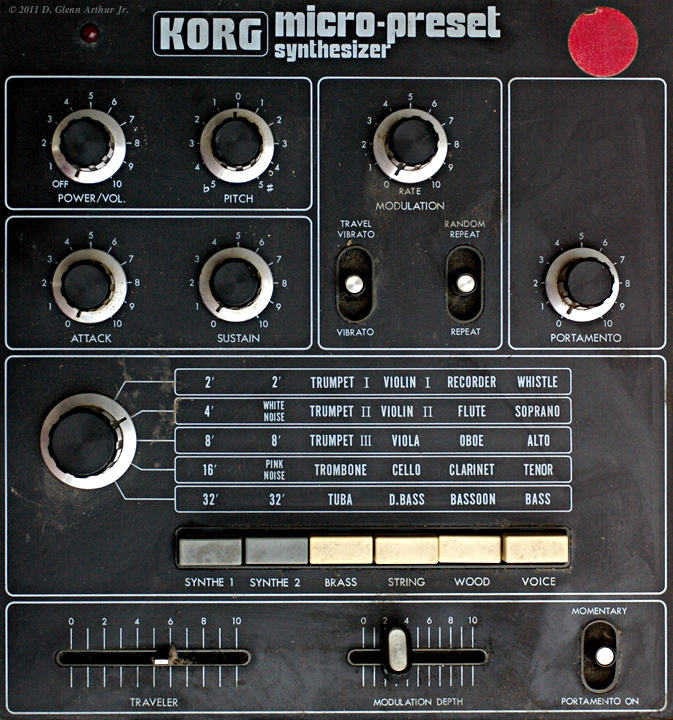
In the process of checking whether my most recent attempt at servicing the keyboard had done any good, I noticed another problem -- with the, uh, synthesizer part of the synthesizer. This is a Korg Micro-Preset (M500), and as you can see in the last photo in the column of thumbnails to the right, while it does have a few analog controls, the "preset" heart of it is the rotary octave selector and the six buttons to select between filter settings that are supposed to mimic various things. Well, a few columns in that matrix -- a few of the buttons -- aren't producing any sound. So far, I don't know whether that's because of faults in the switches themselves, or some more ominous fault in the guts of the circuitry. (I guess I should try jumpering around the switches with test leatds or something the next time I plug the beastie in.)
I did find a PDF of a manual that includes a schematic ... Whoever scanned the printed manual to make the PDF did so at a resolution that makes the schematic not at all useful. (Some labels are clear, like "OCTAVE", but not only are component values mere smears of black pixels, some of the component symbols can't even be distinguished -- some resistors are really blurry wiggles, and others are just oblong blobs, and there are some blotches that could be either capacitors or diodes.) So if it comes down to making sense of the circuitry, the manual I found won't help much. I really hope it's just the switches.
I'd love to have this sucker working again before the next time I load the wall of instruments into the van for a filk convention -- more for the show-and-tell value, since analog synthesizer technology seems to have been kind of forgotten about (and really, something like a Mini-Moog would be better for demonstrating the differences between analog and digital synths, but the Korg is what I have) than to use in performance -- but I don't really expect to manage that. Still, I should give it a shot, right?
Any clues?

(no subject)
-keith_m043
(no subject)
(no subject)
(no subject)
(no subject)
I'd recommend Kevin Lightner at synthfool.com, but he's not taking any more repair requests at this time. He has a rather comprehensive Korg manual page at http://www.synthfool.com/docs/Korg/.
(no subject)